
Reviewed · FIRE TEMPLE & BURNING MOUNTAIN TOURS
Ateshgah Fire Temple and Yanardag Fire Mountain Private Tour
Atesgah and Yanardag tell two different fire stories. One is a carefully preserved pilgrimage site tied to Zoroastrians, Hindus, and Sikhs. The other is a natural gas flame still burning from a hillside near the Caspian Sea. The contrast is the real appeal.
I like the private format, since you can ask questions without waiting for a large group. I also like the efficient route: about an hour at Ateshgah, then 30 to 60 minutes at Yanardag, with a car handling the long stretches between them. The main drawback is that admission costs extra, and the tour can feel brief if you want a slow, museum-style visit.
Key points to know before booking
- Two fire sites in one short outing: See a historic temple and a natural gas flame on the Absheron Peninsula.
- A private English-speaking guide: Your group travels alone, with guides associated with the service including Aga, Fuad, and Anar.
- Transport is included: An air-conditioned vehicle handles pickup, the drives between stops, and the return to central Baku.
- Plan for extra entrance fees: The estimated combined admission is $9 per person, not included in the $55 tour price.
- The timing is compact: The full experience takes about 3 to 4 hours, including pickup and return.
- A good afternoon choice: The route offers a simple way to see two places outside central Baku without arranging separate transport.
Why Baku’s fire sites are worth your time
Azerbaijan’s connection with fire is more than a colorful legend. Natural gas has long seeped from parts of the Absheron Peninsula, where the ground once supplied fuel for flames that could burn without an obvious source. Those fires helped shape religious practice, local stories, and the region’s identity.
Ateshgah gives you the human side of that story. Yanardag gives you the geological side. Put together, they make a more useful visit than either site alone.
I would not book this as a full-day cultural tour. It is a focused half-day trip with limited walking, a private vehicle, and enough time to understand the main points. If your Baku schedule is tight, the 3 to 4-hour length makes it easy to fit around other plans.
The tour costs $55 per person. That price includes the English-speaking guide and air-conditioned vehicle, but not the entry tickets. With the estimated $9 combo admission added, you should budget about $64 per person before food or drinks.
That is reasonable if you value a private car and direct explanations. It is less attractive if you are traveling alone and mainly want a quick look at the sites. For two or more people, the convenience of private transport becomes easier to justify, especially because the sites are outside central Baku.
More fire temple and burning mountain trips:
- Baku: Gobustan, Volcanoes, Fire Temple and Yanardag Day Trip
★ 4.7 · 433 reviews - Gobustan & Mud, Fire Temple, Burning Mountain (Group & Private)
★ 4.5 · 418 reviews - Gobustan-Mud Volcan-Fire Temple and Mountain Tour/Entrance inc
★ 5.0 · 267 reviews
Entering the pentagonal Ateshgah Fire Temple
The first stop is Ateshgah, also called the Fire Temple. From central Baku, the drive takes about 30 minutes by car, though the pickup time is included in the advertised tour length.
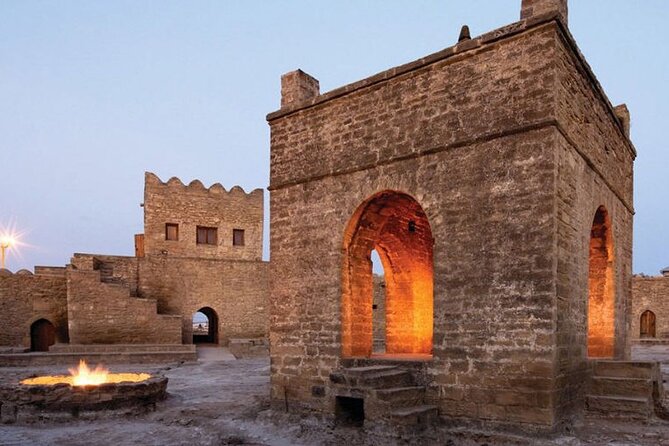
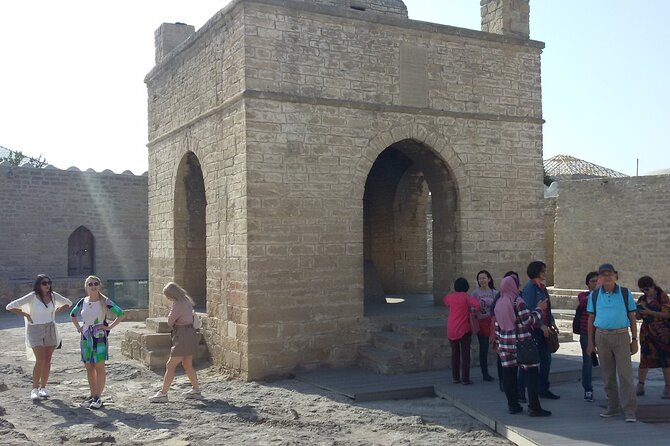
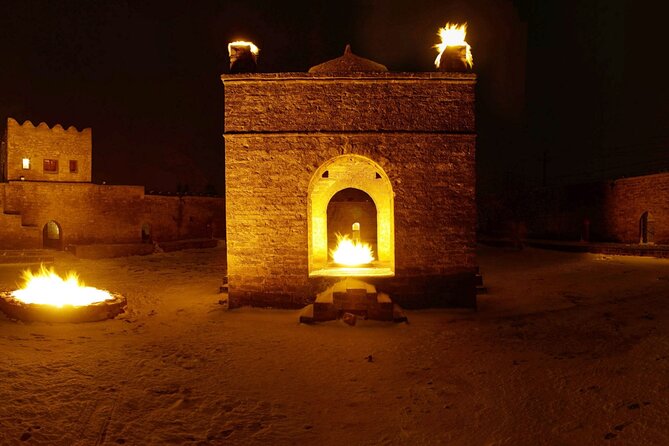
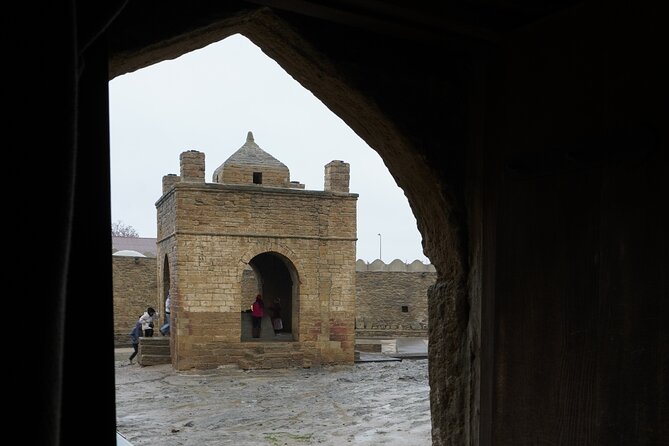
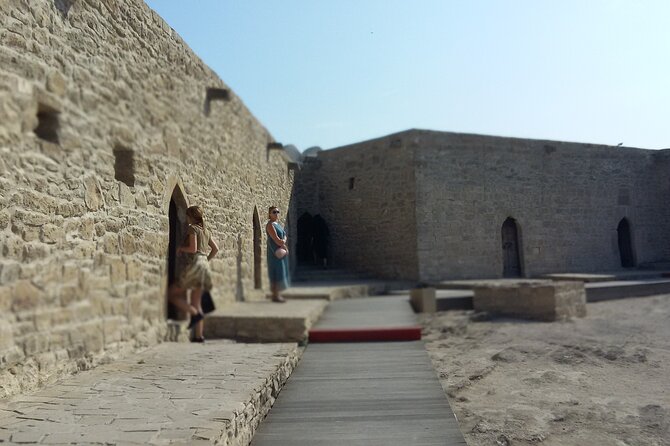
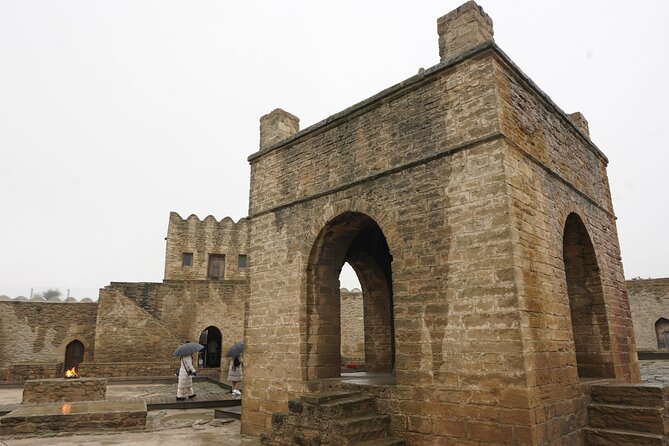
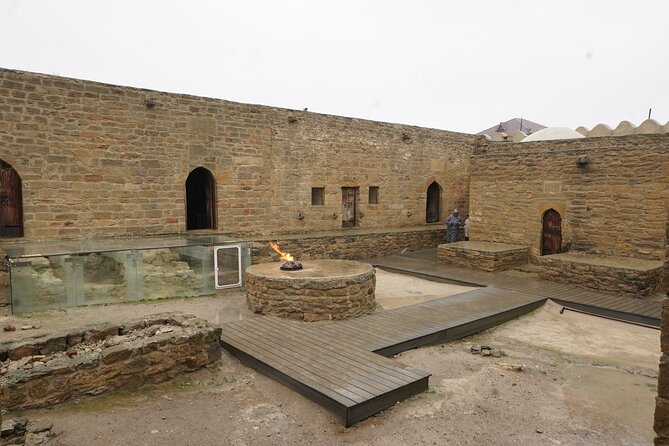
The complex has a distinctive pentagonal shape. Its outer walls enclose small cells that once served as rooms for monks or religious visitors. At the center is a four-pillared altar, the visual focus of the courtyard and the place where fire worship took place.
The site was used for roughly 300 years by Zoroastrians in Azerbaijan. It was also revered by the Baku-based Hindu community connected with Sikh traditions. That detail gives the temple a wider story than the simple label of an ancient fire shrine.
Inside the courtyard, your guide should help separate the different religious threads. Ateshgah was not only a place for one local tradition. It was part of a pilgrimage network shaped by merchants, religious visitors, and communities with links beyond Azerbaijan.
You are scheduled to spend about one hour here. That is enough to walk around the courtyard, look into the surrounding cells, study the altar, and hear the main historical explanation. It is not a long research visit, so ask questions early if you want more detail about Zoroastrian practice or the Hindu and Sikh connection.
The temple was abandoned in the late 19th century, probably as the Indian population in the area declined. That change is important because the site was not simply left behind after one dramatic event. Its use faded as the people and conditions that supported it changed.
Ateshgah was nominated for the UNESCO World Heritage List in 2007 and later declared a state historical-architectural reserve. Those designations do not make the visit automatically fascinating, but they do show why the complex receives official protection and careful attention.
The drawback is that some of the courtyard can feel more architectural than atmospheric. The original religious activity is gone, and the modern visitor experience is structured around preserved buildings and interpretation. Go for the setting, the unusual religious history, and the central altar, not for a functioning temple ceremony.
Admission is not part of the tour price. The estimated combined ticket for Ateshgah and Yanardag is $9 per person. Carry that extra amount in your planning, since the advertised $55 covers the guide and vehicle rather than the two attractions.
The long drive across the Absheron Peninsula
After Ateshgah, you drive about 50 minutes to Yanardag. This is the longest transfer of the outing, and it is one reason the private vehicle matters.
The drive breaks up the two visits and keeps you from having to work out separate transport to sites outside the city center. In a private group, you can use the ride to ask your guide about Baku, the peninsula, or the fire traditions connected with the route.
Do not expect a sightseeing drive with a long list of planned roadside stops. The stated program is a direct road trip from one fire site to the other. If you want photographs or extra detours, ask the guide at the start, but the published plan is focused on the two main attractions.
Because pickup and return are included in the total duration, the actual time at the sites is shorter than the headline 3 to 4 hours. That is normal for an out-of-town half-day tour, but it is worth understanding before you book.
Watching the flame at Yanardag
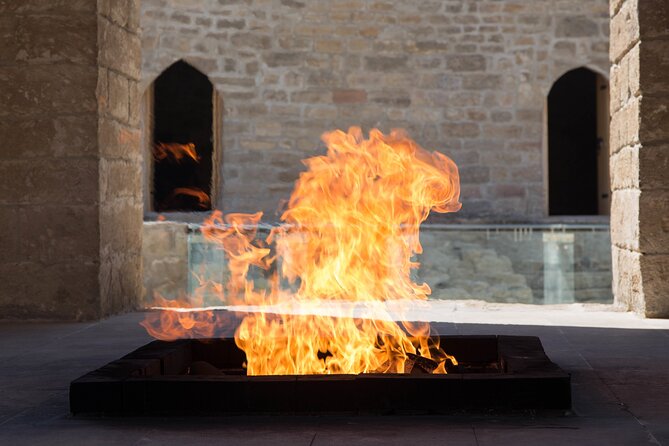
Yanardag means Burning Mountain, and the site offers a very different experience from Ateshgah. Here, natural gas seeps from below the ground and burns continuously on a hillside.
The flame burns fairly steadily because the underground gas supply continues. Unlike the mud volcanoes near Lokbatan or Gobustan, Yanardag has no mud or liquid flowing from the ground. That makes the fire easier to observe and gives it a clean, direct quality.
You spend about 30 to 60 minutes at the site. The shorter visit may be enough if you mainly want to see the flame and take photographs. The longer version allows time to walk around the larger area and hear an explanation from the guide.
The fire itself is not a huge theatrical display. Its appeal comes from the oddness of seeing flames rise naturally from a hillside. During daylight, it may look more modest than you expect. That is not a flaw, but you should approach it as a natural phenomenon rather than a staged attraction.
Yanardag is a state-protected conservation area. The protected status helps preserve the site and gives the visit a clear environmental and historical purpose. You are seeing one of the peninsula’s most famous natural gas fires, not simply a decorative flame made for tourists.
This stop also completes the story begun at Ateshgah. At the temple, fire was placed at the center of worship. At Yanardag, the source is still part of the earth itself. Your guide’s explanation can help connect those two ideas without treating them as the same thing.
The itinerary sometimes describes this stop as 30 minutes, while the fuller plan allows 30 to 60 minutes. I would expect a fairly quick visit, with some flexibility depending on the guide and the pace of your group.
A few more Baku half-days to weigh up
- Baku: Gobustan, Mud Volcano, Fire Mount, Temple Lunch Entry
★ 4.9 · 3,246 reviews - Baku: Guba, Shahdag, Laza & Lunch w/ Free City & Night Tour
★ 4.8 · 1,455 reviews - BEST Gobustan, Volcanoes & Absheron Fire Tour (Group or Private)
★ 5.0 · 1,254 reviews - Gobustan and Absheron tour (All inclusive)
★ 5.0 · 1,014 reviews
What the private format adds
This is a private activity, so only your own group participates. That is the strongest practical feature for many people.
A private tour lets you control the pace within reason. At Ateshgah, you can spend more time on the altar or the former cells if those details interest you. At Yanardag, you can ask for a fuller explanation instead of simply taking a quick look and moving on.
The guide also becomes more useful in the car. Since the two sites are separated by substantial driving time, an English-speaking guide can turn the transfers into part of the experience. Guides associated with this service include Aga, Fuad, and Anar.
Aga is specifically associated with careful explanations, answers to questions, and useful city tips. Anar is associated with guiding and driving, while Fuad has been described as helping with arrangements and remaining reachable when support was needed. Those names may not identify the guide assigned to your booking, so confirm the guide details if a particular person matters to you.
The service has also handled broader trip support for some bookings, including assistance during a snow-related problem in Gabala. That does not form part of this fire temple tour, and you should not book this experience expecting a wider travel-concierge service. Still, it suggests that the operator may be responsive when plans become complicated.
Timing, pickup, and the return to Baku
Pickup is offered, and the meeting information gives NizamiBadalan mektebin yolu, Aşurlu 1009, Azerbaijan as the starting point. The activity ends back at the meeting point, or at the city-center hotel when hotel pickup and return have been arranged.
Confirm your pickup details after booking. The booking confirmation is issued at the time of reservation, and the pickup time counts toward the total tour duration.
The tour is near public transportation, but the included vehicle is the more practical choice for this route. Ateshgah and Yanardag are not a compact pair in central Baku, and arranging transport between them would add time and uncertainty.
Most people can participate, according to the supplied tour information. No special access limitations are stated, so ask the provider directly if you have specific mobility concerns or need detailed information about walking surfaces.
The route works well in the afternoon, when you want to spend the morning in central Baku and return with time left for dinner. I would avoid placing an important fixed booking immediately after it, since city traffic and pickup timing can affect the return.
How the $55 price compares with the experience
At $55 per person, this is not the cheapest possible way to see two attractions. Public transport or a self-arranged taxi could cost less, though the tour data does not provide a comparison price. The real question is what you are paying to avoid.
You are paying for an English-speaking guide, an air-conditioned vehicle, pickup options, the transfer between two out-of-center sites, and a private group format. You are also paying for a clear route that does not require you to negotiate transport between Ateshgah and Yanardag.
The extra $9 admission estimate matters. The actual combined ticket price is listed as an estimate, so treat it as a planning figure rather than a guaranteed final amount. Food and drinks are also excluded, though the tour is short enough that most people can manage without a meal during the outing.
I see the best value for couples, families, and small groups that want privacy and a guide’s explanation. Solo visitors should think harder about the per-person cost, especially if they are comfortable arranging their own transport and reading the site information independently.
Who should book this fire-focused outing
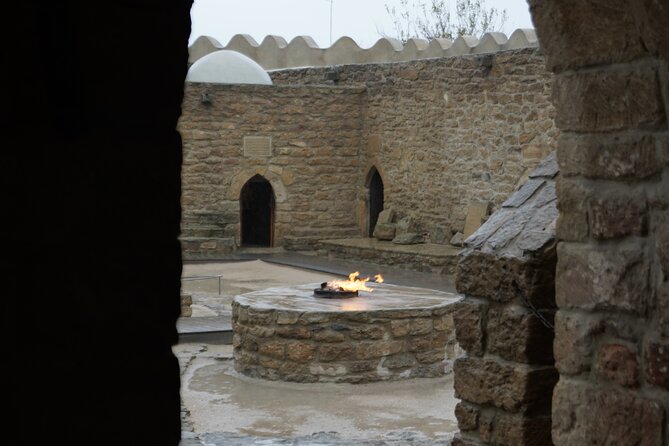
You should consider it if you want to understand why fire became such a strong symbol in Azerbaijan. The pairing of a former place of worship with a live natural flame gives the trip a clear theme and avoids a scattered list of unrelated sights.
It also suits first-time visitors who want an easy excursion beyond central Baku. You do not need to plan a full day, and the air-conditioned car makes the route less tiring than arranging multiple rides.
Families may appreciate the short visits and unusual subject. Children may find the continuously burning hillside more memorable than a conventional monument, while the temple gives adults more historical material to discuss.
History-minded visitors should ask the guide about the 300-year period of Zoroastrian use, the Indian and Sikh links, and the temple’s late 19th-century abandonment. Those details make Ateshgah far more interesting than a quick photo stop.
You may want to skip it if your Baku plans already include a longer Absheron or Gobustan excursion, or if you expect large flames and dramatic volcanic activity. Yanardag is a steady gas fire, not a mud volcano, and Ateshgah is a preserved complex rather than an active place of worship.
My booking advice
I would book this tour if you want a short, private introduction to two of Azerbaijan’s best-known fire sites. The route is simple, the transport solves a real problem, and the private guide format gives you room to ask questions.
Before paying, confirm three things: your exact pickup point, the name of your guide, and the current combined admission price. If you need to cancel, you can receive a full refund when you cancel at least 24 hours before the start time. Changes or cancellations within 24 hours are not refunded.
The tour is most worthwhile when you treat it as a focused cultural and natural-history outing. Ateshgah explains the human meaning of fire. Yanardag shows the geological source that helped inspire it. That is a compact lesson, and a useful one, in Baku’s relationship with the land beneath it.
FAQ
How long does the Ateshgah and Yanardag tour take?
The full tour takes approximately 3 to 4 hours, including pickup and the return to the meeting point or central Baku hotel.
What sites does the tour visit?
The tour visits Ateshgah Fire Temple and Yanardag, also called Fire Mountain, on the Absheron Peninsula.
Is the tour private?
Yes. Only your own group participates in this private activity.
Is hotel pickup available?
Pickup is offered from a hotel or a defined meeting point. The listed starting point is NizamiBadalan mektebin yolu, Aşurlu 1009, Azerbaijan.
Is transportation included?
Yes. An air-conditioned vehicle and an English-speaking professional guide are included.
Are the entrance tickets included in the $55 price?
No. Admission to the Fire Temple and Fire Mountain is not included. The estimated combined ticket price is $9 per person.
How much time is planned at Ateshgah?
The planned visit at Ateshgah lasts about one hour.
How much time is planned at Yanardag?
The visit at Yanardag lasts about 30 to 60 minutes, depending on the pace of the outing.
How far is Ateshgah from central Baku?
The drive from central Baku to Ateshgah takes about 30 minutes by car.
Can I cancel for a full refund?
Yes. You can cancel at least 24 hours before the experience start time for a full refund. Cancellations or changes made within 24 hours are not refunded or accepted.
Just added around Baku
- Guba and Shahdag City Tour★ 5.0 · 3 reviews
- Lunch included Qobustan, Mud Vulcano, Ateshgah Temple & Yanardag Fire Mountain★ 4.5 · 3 reviews
- Baku’s Ancient Heart★ 5.0 · 3 reviews
- Baku: Secret Tour with Surprise Activity★ 5.0 · 3 reviews
- Baku: Old City Guided Walking Tour★ 4.6 · 3 reviews
- Majestic Journey to Qobustan and Absheron★ 4.5 · 3 reviews
- Lahij – village of masters★ 4.5 · 3 reviews
- Baku night tour★ 5.0 · 3 reviews
Fire Temple & Burning Mountain Tours, compared.
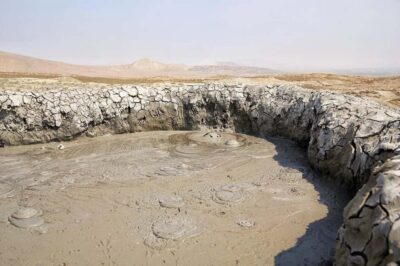
Gobustan, Volcanoes, Fire Temple and Yanardag Day Trip
Read our review →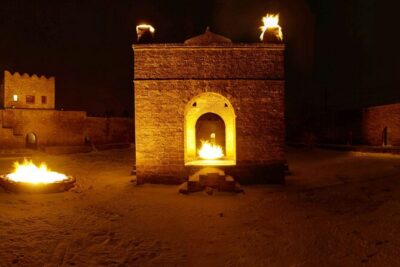
Gobustan-Mud Volcan-Fire Temple and Mountain Tour/Entrance inc
Read our review →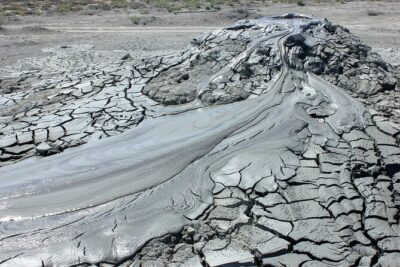
Gobustan, Mud volcanoes, Fire temple, Fire mountain PRIVATE TOUR
Read our review →
Gobustan & Mud, Fire Temple, Burning Mountain, H.A. Center
Read our review →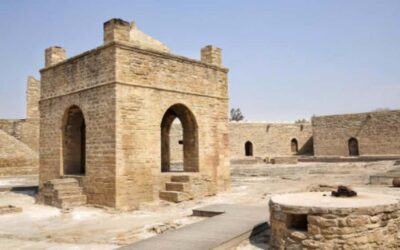
Gobustan, Mud Volcanoes, Fire Temple, & Yanar Dag Tour
Read our review →
Atashgah Fire Temple & Burning Mountain Half-Day Tour
Read our review →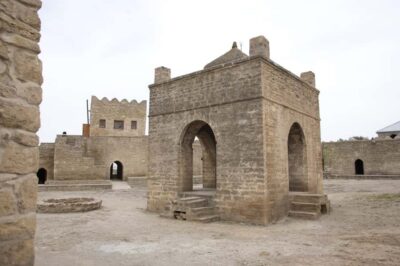
Burning Mountain & Zorastrian Temple Private Tour
Read our review →Browse the lists this tour appears in