
Reviewed · BAKU TOURS
Baku Soviet Architecutre Gudied Walking Tour
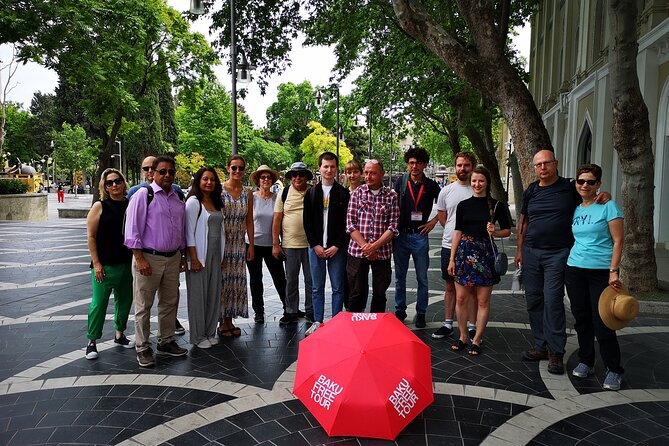
Baku’s story is written in layers: oil wealth, Russian influence, Soviet power, national revival, and today’s polished capital. This 2.5-hour walking tour connects those layers through central streets, grand buildings, public squares, and the Caspian waterfront, with guide Gani adding local stories about daily life, legends, music, and modern Baku.
I like the route’s mix of famous places and less obvious corners, especially the contrast between the ornate home of oil baron Haji Zeynalabdin Taghiyev and the giant Soviet Government House. I also like the small-group format, capped at 15 people, since you can ask questions and the pace can be adjusted. The main consideration is simple: this is a walking tour with many stops, so hot weather, hard pavement, or limited mobility could affect your enjoyment.
Key points at a glance
- See Baku’s oil-boom elegance beside Soviet scale: The route moves from Taghiyev’s former residence to the imposing Government House.
- Follow the city’s main social streets: Fountain Square, Nizami Street, Khagani Street, and Baku Boulevard show how Baku works today.
- Learn through local stories: Gani focuses on residents, legends, language, music, literature, and changing social life.
- Keep your afternoon flexible: The tour begins at 1:00 pm, lasts about two and a half hours, and returns to the starting point.
- Ask questions without losing the group: The maximum group size is 15, with mobile ticketing and a clear meeting point.
- Finish with Azerbaijani tea: Coffee or tea at a local coffee shop is included at the end.
Why this Baku walking tour is more than a Soviet architecture stroll
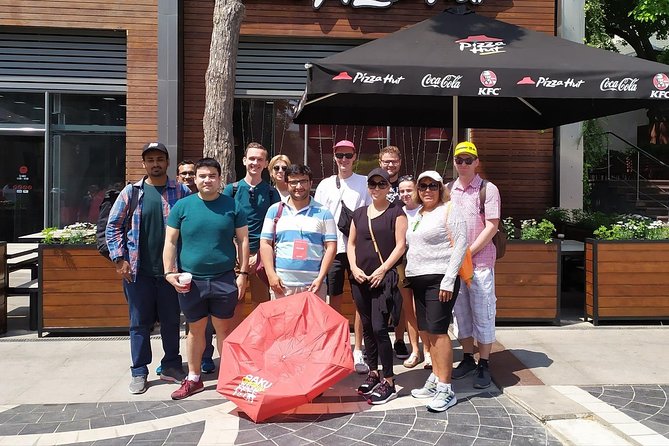
The title points you toward Soviet architecture, but the actual experience is broader and more useful for a first look at Baku. You are not simply stopping in front of concrete buildings and hearing dates. The route explains how oil money shaped the city, how Soviet rule affected public life, how Russian culture fits into Azerbaijani society, and how music and literature helped build national identity.
That wider frame is the tour’s strongest feature. Baku can seem like several cities placed side by side: an old oil capital, a Soviet administrative center, a modern shopping district, and a seafront city of promenades and monumental buildings. This walk helps you connect those pieces.
The guide, Gani, is repeatedly praised for clear English, patience, humor, and his ability to answer questions. That matters here because the subject is not always easy to reduce to a few facts. The tour touches on identity, language, religion, migration, national feeling, and the way local people use the center after work.
You should also expect a conversational tour rather than a silent march between photo stops. The guide can discuss local hangouts, Baku nightlife, and places people actually use, which gives the route a useful present-day angle.
More walking tours in Baku:
- Baku: Stunning Walking Tour of Historical and Modern City
★ 4.9 · 270 reviews - Baku Oil Heritage & Old Town Walking Tour
★ 5.0 · 232 reviews - Baku Walking Tour (Old City)
★ 5.0 · 127 reviews
Starting at Fountain Square and Nizami Street
The tour begins and ends at Karnaval, at 353 Istiglaliyyat, near Fountain Square. The square is a practical place to begin because it sits in the center of Baku’s entertainment district and gives you an immediate sense of the city’s public life.
Fountain Square is not only a modern leisure area. Its roots reach back to Baku’s first oil boom in the late 19th and early 20th centuries, when the area developed as an important trading street. Your guide uses that setting to explain how oil transformed Baku from a regional town into a major commercial center.
You spend about 15 minutes here, without an admission charge. It is enough time for an introduction and orientation, though not enough for a long architectural survey. I would treat this as the opening chapter, not as a standalone sightseeing stop.
From here, the route continues along Nizami Street, the central shopping and entertainment spine of modern Baku. About 800 meters of the 3.5-kilometer street is closed to traffic, making this one of the easier sections for walking and people-watching.
Nizami Street is valuable because it shows Baku in use. Shops, restaurants, concert halls, and theaters line the route, and the street fills with people relaxing after work. You get to hear how the city center functions now, while the surrounding buildings keep the discussion tied to earlier periods.
The scheduled stop is another 15 minutes. Since this is a busy commercial street, you may want to return on your own later if you hope to shop, eat, or study the façades at a slower pace.
Stalinist architecture near the Nasimi Monument
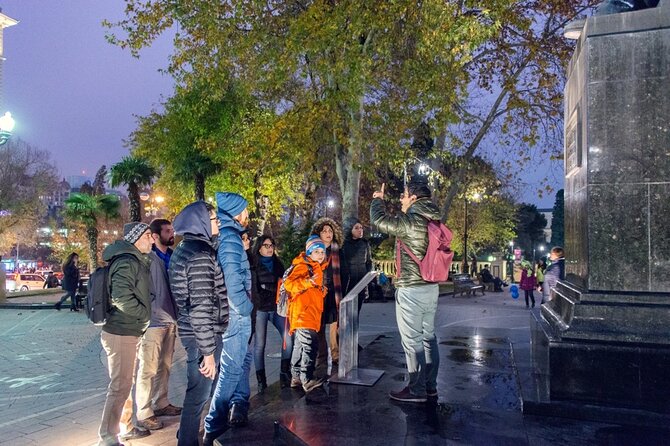
At the intersection of Samad Vurgun and Nizami streets, the tour pauses near the Nasimi Monument. This is one of Baku’s busy central junctions, but the important feature is the view toward the city’s Stalinist architecture from the 1950s.
The architecture here helps explain the Soviet city as a public statement. Large façades and formal design were meant to convey order, importance, and state power. A guide can point out how this visual language differs from the private wealth and ornate decoration associated with Baku’s oil barons.
The stop lasts around 15 minutes and costs nothing. Because it is an intersection rather than an enclosed site, the experience depends on the explanation and the view. You will not be entering a building here, so this section suits people who want urban context more than interior sightseeing.
Nizami Cinema, Qara Qarayev, and nation-building
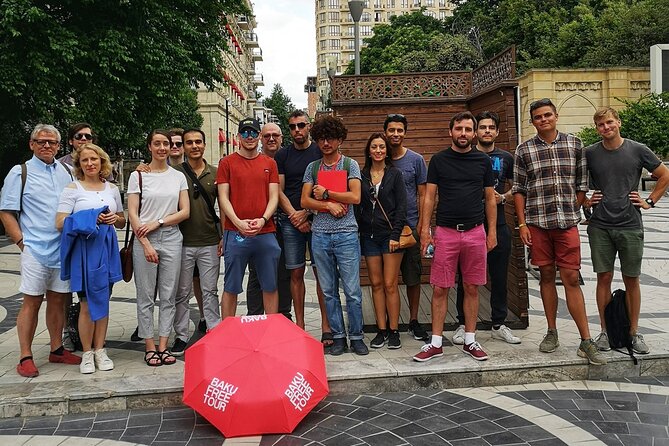
The next stop brings the discussion toward 28 May Street and Nizami Cinema. The street commemorates Azerbaijan’s first independence in 1918, giving the guide a natural opening to discuss the country’s attempts to define itself as a nation.
A statue of Qara Qarayev, one of Azerbaijan’s major classical composers, adds a cultural focus. The tour uses music and literature to explain how national identity was shaped. That is a welcome change from a tour that treats politics and buildings as separate subjects.
You spend about 15 minutes here. The point is less about entering the cinema and more about seeing how public monuments, cultural figures, and streets can carry national meaning. If you are interested in Azerbaijan’s cultural life, this may be one of the more rewarding stops.
The tour’s pop-culture label also makes more sense here. The guide links older artistic traditions with the way Baku presents itself today, rather than treating Soviet architecture as a sealed-off historical period.
A few more Baku half-days to weigh up
- Baku: Gobustan, Mud Volcano, Fire Mount, Temple Lunch Entry
★ 4.9 · 3,246 reviews - Baku: Guba, Shahdag, Laza & Lunch w/ Free City & Night Tour
★ 4.8 · 1,455 reviews - BEST Gobustan, Volcanoes & Absheron Fire Tour (Group or Private)
★ 5.0 · 1,254 reviews - Gobustan and Absheron tour (All inclusive)
★ 5.0 · 1,014 reviews
The opera district and Baku’s cultural institutions
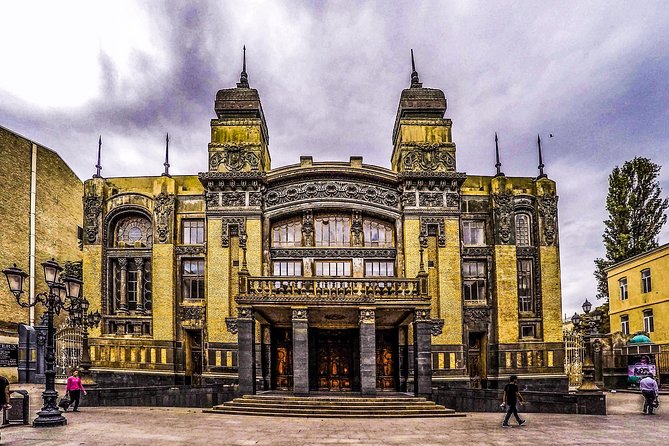
The walk through the cultural section of Nizami Street includes the Song Theatre, National Library, Azerbaijan State Academic Opera and Ballet Theater, and a reference to Lev Landau, the Nobel Prize-winning physicist.
The scheduled time for the opera and cultural section is listed as 15 minutes, although the route description also describes more than half an hour of walking through this part of Nizami Street. You should allow for the full tour length of approximately two and a half hours rather than trying to calculate every stop as an exact quarter-hour.
This portion shows that Baku’s identity is not limited to oil, politics, or grand construction. The opera house, theater, library, music, and science all form part of the city’s public culture. I like this balance because it keeps the tour from becoming a narrow architecture lecture.
You should not expect admission to these institutions. They are viewed from the route, and the value comes from the guide’s explanation of their role in Baku’s cultural development.
Khagani Street and the Russian influence on Baku
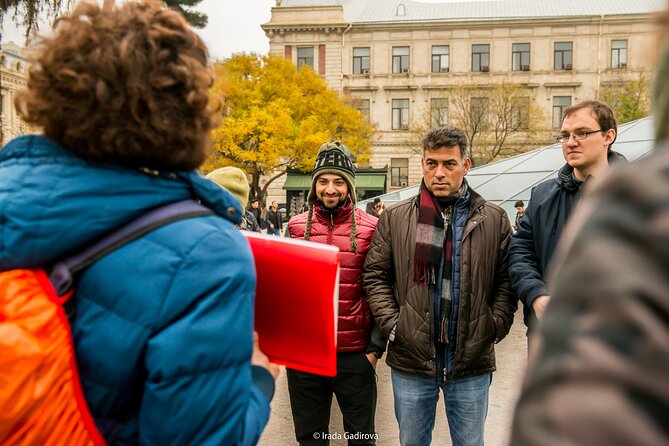
Khagani Street, historically known as Molokanskaya, opens another useful line of discussion. The name refers to spiritual Christians who were exiled from Russia to Azerbaijan. Khagani Park, formerly Molokan Park, and the Russian Drama Theatre remain reminders of the area’s Russian connection.
This is one of the more distinctive parts of the route because it deals with people, language, and society rather than only buildings. You hear about the place of Russian language and Russian communities in Azerbaijani life, subjects that can be difficult to understand from a guidebook paragraph.
The stop takes about 15 minutes. It is particularly useful if you want to understand Baku as a crossroads of cultures. The city’s story includes Azerbaijani traditions, Russian influence, oil-driven international connections, Soviet rule, and an independent national identity.
The route does not present these influences as a simple choice between old and new. Instead, it shows how they coexist in the center. That is one reason the tour works well as an introduction during a short stay.
Taghiyev’s former residence and Baku’s oil fortune
The National Museum of History of Azerbaijan occupies the former private residence of Haji Zeynalabdin Taghiyev, often called the father of the nation. The building is presented as a place of ornate decoration, grand interior design, and major moments in modern Azerbaijani history.
The central story is Taghiyev’s rise from poverty to great wealth. His life gives the oil boom a human face. Rather than hearing only that Baku became rich from petroleum, you get a story about how one local figure moved from very modest beginnings to a position of national importance.
The stop is scheduled for about 15 minutes, and there is no museum admission included. You should understand this as an exterior visit and storytelling stop, not a museum tour. If the interior interests you, you may want to return separately and allow enough time for a proper visit.
For me, this is one of the route’s best contrasts. Earlier, you have been looking at Soviet public architecture. Here, the emphasis shifts to private wealth and decorative ambition from the oil era. The two periods tell very different stories about who held power and how that power was displayed.
Government House and the scale of Soviet Baku
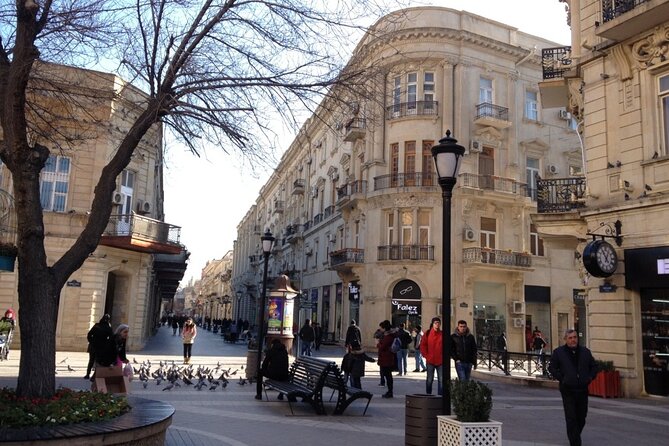
Government House is the route’s clearest Soviet landmark. The building is described as a gigantic and iconic Soviet structure, and its size makes the political message easy to grasp even before the guide explains it.
This is a good place to pause and consider the difference between an individual mansion and a state building. Taghiyev’s residence expresses personal wealth. Government House expresses government authority, collective administration, and the scale of the Soviet system.
The scheduled stop is about 15 minutes. Again, you are viewing the landmark from outside, so the quality of the explanation matters more than access. Gani’s role is to connect the structure to Baku’s modern development, not simply point out its date or architectural style.
If Soviet-era city planning is your main reason for booking, this stop will be a highlight. If you want a detailed tour of interiors, the experience may feel limited because the route stays outdoors.
The final walk along Baku Boulevard
The tour ends with Baku Boulevard, also called Dənizkənarı Milli Park. This seafront promenade was established in 1909 and runs parallel to the Caspian shore.
The boulevard’s origin is tied to Baku’s oil barons and the gradual construction of an artificial seafront. That detail helps explain why the waterfront feels like an engineered civic space rather than simply a natural beach edge. The city’s wealth and ambitions reshaped the shore over time.
You spend about 20 minutes here, the longest single scheduled stop. It is a fitting ending because the boulevard brings together Baku’s past and present: oil wealth, public recreation, grand urban planning, and modern city life beside the Caspian Sea.
The waterfront also gives the walking route a change of pace. After streets, intersections, theaters, and government buildings, you finish in a more open setting. The tour returns to the original meeting point, and the included cup of local tea at a coffee shop adds a relaxed finish.
What the $60 price gets you
At $60 per person, this is not the cheapest way to walk around central Baku. Most of the stops are public spaces, and no major admission tickets are included. You are paying mainly for the guide’s time, route design, language skills, historical interpretation, and local perspective.
That can be good value if you have only a short stay or prefer to understand what you are seeing rather than simply photograph it. The route covers oil-era Baku, Soviet architecture, cultural institutions, Russian influence, modern shopping streets, and the waterfront in one compact afternoon.
The maximum group size is 15, which is small enough for questions without promising a private tour. The experience also offers group discounts, though the supplied details do not state the discount amount.
I would compare this tour with the cost of arranging several separate visits or hiring a private guide. If you already plan to walk these streets on your own and mainly want photographs, $60 may feel high. If you want a clear narrative and help finding less obvious connections, the fee is easier to justify.
Timing, walking pace, and practical planning
The start time is 1:00 pm. That leaves your morning free for another activity and makes this a useful afternoon introduction to central Baku. It also means you should plan for changing light and, depending on the season, warm conditions during the outdoor walk.
The tour lasts approximately two hours and 30 minutes. The route includes nine stops, with most scheduled for 15 minutes and the boulevard for 20 minutes. There is no private transportation, so expect to move on foot from beginning to end.
Wear comfortable shoes and bring water, especially if the weather is warm. The tour requires good weather, and it can be canceled if conditions are poor or if the minimum number of participants is not reached. In either case, you are offered another date or experience, or a full refund.
The meeting point is Karnaval, 353 Istiglaliyyat, Baku 1005. Confirmation is provided at booking, and a mobile ticket keeps the arrival process simple. The meeting point is near public transportation, though no specific route or station is provided.
Service animals are allowed, and most people can take part. Still, this is an outdoor walk with repeated stops and no private vehicle, so anyone concerned about distance or pavement should contact the provider before booking.
Who will get the most from this experience
I would recommend this tour to a first-time visitor who wants a clear introduction to central Baku. It is especially useful if you have only a day or two and want to learn how the main districts connect before exploring them alone.
It also suits you if you enjoy architecture but want more than building names and construction dates. The guide discusses residents, legends, cultural figures, language, music, literature, nightlife, and social habits, giving the walk a human side.
The tour should appeal to people interested in the Soviet period, although it is not limited to Soviet history. You will also spend time with oil-boom architecture, national independence, Russian influence, and the modern city center.
You may want a different experience if you need museum entry, a private guide, extensive time inside historic buildings, or transportation between sights. This is a public-street tour, and its success depends on your interest in listening while walking.
Should you book the Baku Soviet Architecture Guided Walking Tour?
Book it if you want Baku explained through its contrasts. The route takes you from oil wealth to Soviet authority, from Russian influence to Azerbaijani national culture, and from shopping streets to the Caspian waterfront.
I especially like it for a first afternoon in the city. Gani’s friendly, patient style and strong English make it easier to ask about sensitive or complicated subjects, while the small group keeps the walk personal enough for conversation.
The $60 price is reasonable for guided context, but less attractive if you only want a quick sightseeing circuit. If you are comfortable walking for two and a half hours and value stories as much as landmarks, this is a strong introduction to Baku.
FAQ
How long does the Baku walking tour last?
The tour lasts approximately two hours and 30 minutes.
What time does the tour start?
The tour starts at 1:00 pm.
Where does the tour begin?
The meeting point is Karnaval, 353 Istiglaliyyat, Baku 1005, Azerbaijan.
Where does the tour end?
The activity ends back at the original meeting point.
How many people can join the tour?
The maximum group size is 15 participants.
Is transportation included?
No. Private transportation is not included, and the experience is designed as a walking tour.
Is food included?
Lunch is not included. Coffee or tea at a local coffee shop at the end of the tour is included.
Are admission tickets included?
The listed stops have no admission charge, and no separate museum or attraction admission is included.
Can I cancel for a full refund?
Yes. You can cancel at least 24 hours before the local start time for a full refund. Cancellations or changes made less than 24 hours before the start are not refunded or accepted.
Just added around Baku
- Guba and Shahdag City Tour★ 5.0 · 3 reviews
- Lunch included Qobustan, Mud Vulcano, Ateshgah Temple & Yanardag Fire Mountain★ 4.5 · 3 reviews
- Baku’s Ancient Heart★ 5.0 · 3 reviews
- Baku: Secret Tour with Surprise Activity★ 5.0 · 3 reviews
- Baku: Old City Guided Walking Tour★ 4.6 · 3 reviews
- Majestic Journey to Qobustan and Absheron★ 4.5 · 3 reviews
- Lahij – village of masters★ 4.5 · 3 reviews
- Baku night tour★ 5.0 · 3 reviews
Baku Tours, compared.
Gobustan, Mud Volcano, Fire Mount, Temple Lunch Entry
Read our review →
Guba, Shahdag, Laza & Lunch w/ Free City & Night Tour
Read our review →
BEST Gobustan, Volcanoes & Absheron Fire Tour (Group or Private)
Read our review →
Candy Cane, Guba, Khinaliq village with Homemade Lunch
Read our review →
Guba & Sahdag Tour Lunch included and Laza Waterfall
Read our review →Browse the lists this tour appears in