
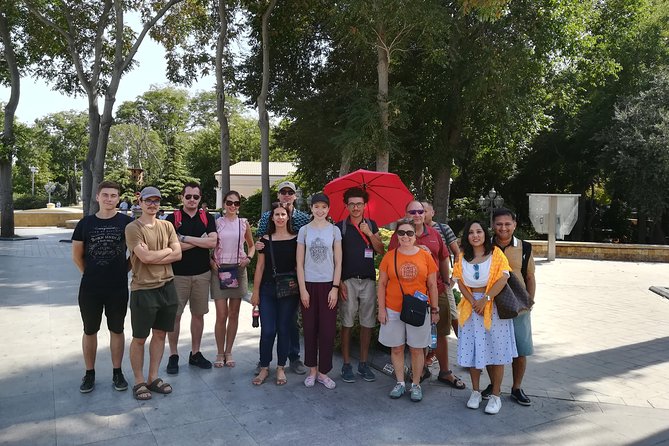
Reviewed · BAKU TOURS
Baku Oil Heritage & Old Town Walking Tour
Baku’s oil story is written in stone. On this 2.5-hour walking tour, you move from the medieval walls of Icherisheher to grand palaces built by oil barons who wanted to look like European princes. Along the way, your guide connects architecture with daily life, Soviet rule, modernization, and Azerbaijan’s first independence.
I like two things here: the route gives you old Baku and oil-boom Baku in one outing, and the guide uses historic photographs and diagrams to show how the city changed. Gani receives especially warm praise for his humor, polished English, and ability to answer questions, while Lina has also led an engaging introduction to the Old City.
The main limitation is simple: you see the Maiden Tower and Shirvanshahs’ Palace from outside, so admission fees are not part of the tour. If you want museum interiors, plan a separate visit and allow extra time.
Key points to know before booking
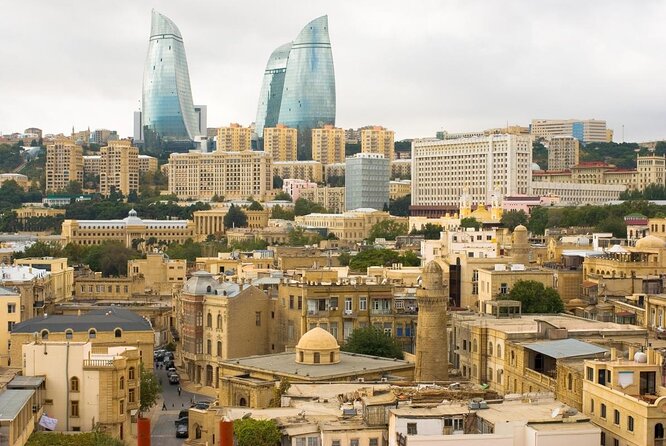
- Baku’s story is told through its buildings: Medieval walls, Gothic revival, European facades, Soviet influence, and modern Azerbaijan all appear along the route.
- The Old City is the heart of the walk: You see the Gosha Gala Gate, Maiden Tower, Muhammad Mosque, narrow lanes, Shirvanshahs’ Palace, and the Museum of Miniature Books.
- The oil boom gets personal: Stories of Taghiyev, his school for Muslim girls, the Palace of Happiness, and Ismailiyya Palace give the era human faces.
- Gani is a major strength: His storytelling, humor, historical knowledge, and use of prepared images have been praised repeatedly.
- There is no sightseeing transport: This is a walking experience, with no private transportation included, so comfortable shoes matter.
- The $70 price buys context, not entry tickets: It is strongest value for a first visit, especially if you want a private guide rather than a self-guided stroll.
Why Baku’s oil story works best on foot
Baku can feel like several cities placed side by side. The Old City is enclosed by medieval walls. Just beyond it, grand nineteenth and early twentieth-century buildings reflect the wealth of the oil boom and the tastes of Russian, European, Muslim, and other communities. Modern Baku then adds another layer.
That contrast is the real subject of this walk. You are not simply checking off a tower, a mosque, and a palace. You are learning why the city grew, who paid for its grand buildings, and how oil money changed Baku’s streets and social life.
I like this approach because the tour gives everyday context to impressive facades. The story includes oil barons and their ambitions, the first secular school for Muslim women, Soviet influence, and the road toward Azerbaijan’s first independence. Those details help you read the city instead of just photographing it.
The guide’s role matters here. Gani is repeatedly praised for his humor, clear English, patience, and command of historical detail. He also uses old photographs and diagrams, which is useful in a city where today’s polished streets can hide what stood there before.
More historic sites near Baku:
- Baku: Stunning Walking Tour of Historical and Modern City
★ 4.9 · 270 reviews - Best of Baku: 4-Hour City Tour Historic and Modern Landmarks
★ 4.7 · 63 reviews - Baku: Historic and Modern Baku Tour ( Day & NIght Tour)
★ 4.5 · 60 reviews
Fountain Square begins and ends the route
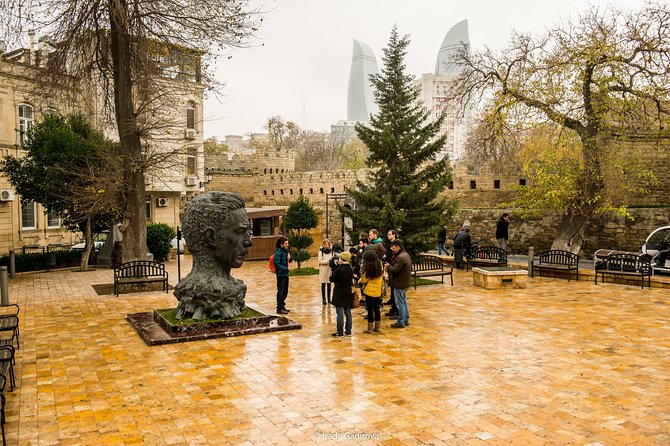
The meeting point is at KFC9RCP+28F on Nizami Street, near Fountain Square. This is a convenient central starting point, and the square also serves as the end of the walk.
Fountain Square is now Baku’s downtown leisure and entertainment center, but the guide places it in a different setting. During the late nineteenth and early twentieth-century oil boom, this area was part of the main trading street of a fast-growing city.
That opening gives you an immediate lesson: Baku’s most familiar central spaces were shaped by commerce long before they became places for an evening stroll. The tour returns here at the end, which makes the route easy to understand and gives you a clear place from which to continue exploring.
The stop itself lasts about 10 minutes. It is not a major sightseeing pause, but it sets up the larger theme of urban change.
Entering Icherisheher through the Gosha Gala Gate
The first major section takes you into Icherisheher, Baku’s Old City. This walled quarter contains four UNESCO World Heritage sites and is the most atmospheric part of the route.
You begin at the Gosha Gala Gate, the main entrance. From there, the walk follows the citadel walls, which date to the twelfth century. The walls help explain why Baku developed as a fortified settlement and make a strong contrast with the open boulevards outside.
The pace is designed for explanation rather than rushing from one photo stop to the next. You walk through narrow streets and pause as the guide points out details that are easy to miss on your own. The route is free of admission charges, but that also means the major interiors are not part of this experience.
Maiden Tower and the limits of an exterior visit
The Maiden Tower is one of Baku’s best-known landmarks. You receive an explanation at the entrance, but you do not go inside.
That distinction matters when you compare this walk with a full Old City sightseeing tour. The outside view gives you the setting and the story, but you will need a separate ticket if you want to climb or explore the tower’s interior. The same basic limitation applies to the Shirvanshahs’ Palace.
For a first orientation, the exterior stop is useful. You can learn where the monument fits within the Old City and hear the guide’s interpretation without spending a long stretch inside one attraction. If the tower is high on your personal list, simply return later with more time.
More walking tours in Baku:
- Baku Walking Tour (Old City)
★ 5.0 · 127 reviews - Baku Old Town Walking Tour with a Local
★ 5.0 · 64 reviews - Baku Downtown Original Walking Tour
★ 5.0 · 36 reviews - Baku Old City Wonders: A Walking Tour Through Time
★ 5.0 · 36 reviews
Muhammad Mosque, narrow lanes, and Shirvanshahs’ Palace
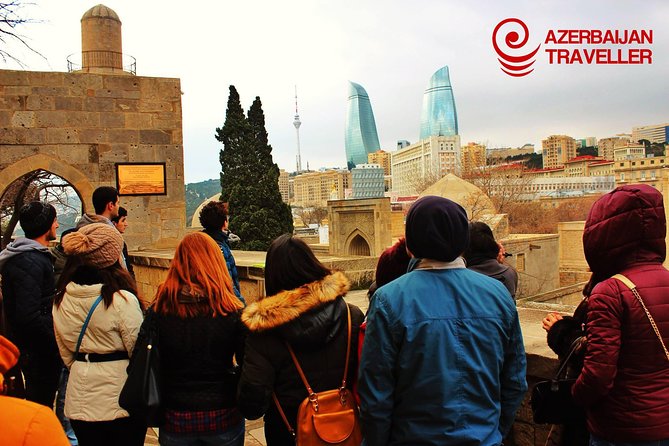
The walk continues to the eleventh-century Muhammad Mosque, another UNESCO site. The stop adds a religious and architectural layer to the Old City, showing that Icherisheher is not just a preserved backdrop. It is a quarter shaped by faith, trade, defense, and domestic life.
The narrow lanes are where the walk feels most different from a standard bus tour. There is time to notice the texture of the stone, the tight street plan, and the way the old quarter turns unexpectedly from one passage to another. A guide is particularly helpful here because the physical setting alone does not explain how Baku’s past fits together.
At Shirvanshahs’ Palace, the guide explains the fifteenth-century complex from outside. Again, there is no interior admission included. You get the historical setting and architectural story, but you should budget separately if you want to see the palace rooms and museum displays.
The Old City section lasts about an hour, making it the longest single portion of the tour. That is sensible. Icherisheher has enough layers to fill an entire morning, and this route gives you a solid introduction without pretending to cover every corner.
The Museum of Miniature Books is also included in the Old City route. The supplied details do not specify an interior visit, so treat it as a stop on the walking itinerary rather than assume admission is included.
Crossing into oil-boom Baku on Istiglaliyyat Street
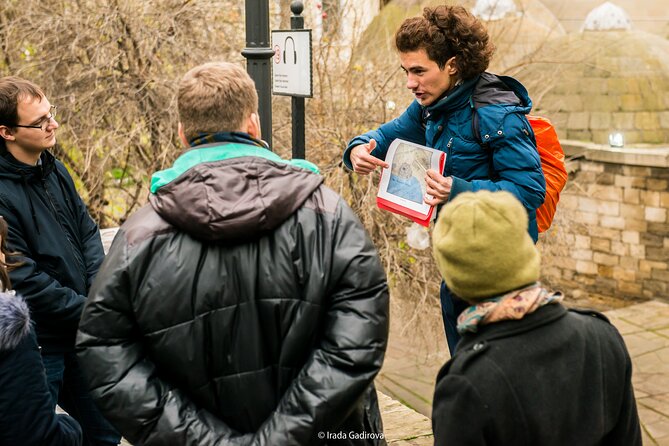
After the Old City, the focus shifts to Istiglaliyyat Street, formerly known as Nikolayevskaya and Kommunisticheskaya. This was one of the main streets of Imperial Russian Baku.
Here, the guide explains how the city expanded beyond its fortress walls and how oil wealth changed its architecture. The oil barons did not merely build offices and factories. They commissioned residences, public buildings, schools, gardens, and institutions that advertised their status and their ideas about progress.
This is where the tour earns its price for many visitors. You see several notable buildings in a compact area, but the guide supplies the connection between them. Instead of treating each facade as an isolated sight, the walk presents a city shaped by ambition, competition, philanthropy, and foreign architectural styles.
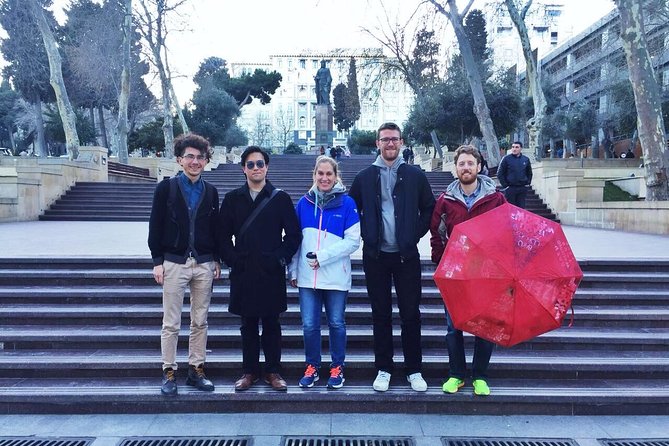
The route covers Governor’s Garden, Baku’s Town Hall, Philharmonic Hall, the Palace of Happiness, the Institute of Manuscripts, Ismaliyya Palace, the Literature Museum, and the statue of Nizami. Not every building receives a long stop, but together they create a useful picture of the city outside the medieval walls.
Philharmonic Fountain and the Ali and Nino connection
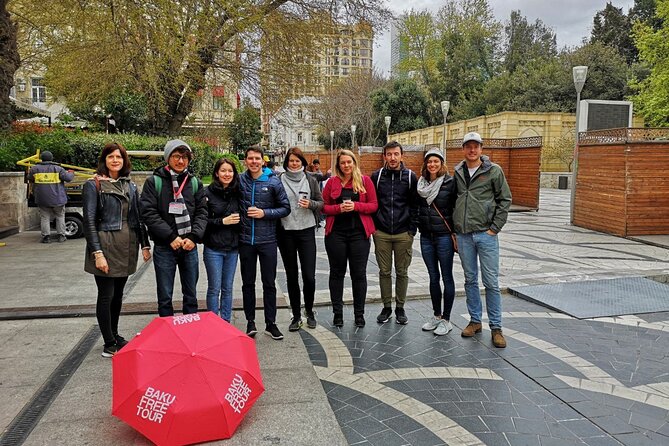
The Philharmonic Fountain marks one of the early landscaped areas created as Baku expanded beyond its fortress. The story of the garden is linked with Ali and Nino, the well-known novel associated with Baku and the region.
This is a short stop of about 10 minutes, but it gives the walking tour a cultural side beyond dates and architecture. The setting helps show how public gardens became part of the growing city and how Baku appears in literature as a place where different cultures and identities meet.
The tour does not promise a literary seminar, so expect a concise connection rather than an extended discussion of the novel. Still, it is a welcome change of pace after the stone lanes and formal facades.
Baku City Hall and the city’s mixed influences
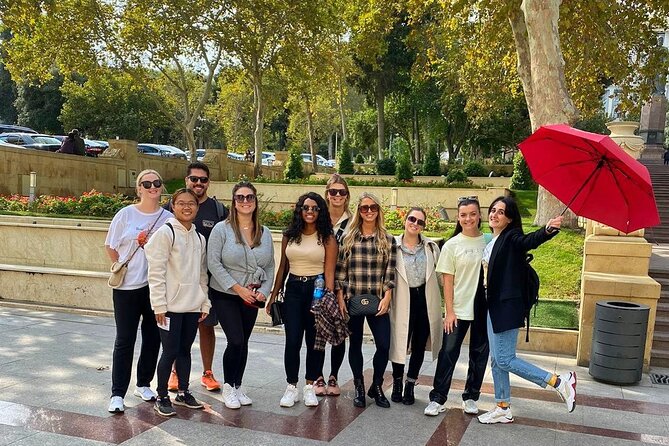
Baku City Executive Power, formerly the town hall, is one of the strongest examples of the oil boom’s monumental architecture. The building helps explain how European design influences arrived in a city whose population and economy were changing quickly.
The guide places the building in the wider setting of a cosmopolitan Baku. Oil drew people and ideas from different communities, and that mixture affected the city’s public architecture. You get more than a photograph of a handsome facade. You learn why a building in Baku might look distinctly European and what that says about the city at the time.
The stop lasts around 10 minutes. Since the tour is conducted from the street, this is about exterior interpretation rather than an interior architectural visit.
Saadet Sarayi and a personal oil-baron story
Saadet Sarayi, also called the Palace of Happiness, brings the oil boom down to a personal scale. The guide tells the story of an oil baron and his wife, whose mansion now serves as a marriage registry.
That use gives the building a continuing role in local life. Rather than treating the palace as a frozen relic, the stop connects its original purpose with what happens there today. It is the kind of detail that makes a walking tour more memorable than a list of construction dates.
You spend about 10 minutes here. The appeal depends heavily on the guide’s storytelling, and this is one of the places where an engaging guide can make a simple exterior stop feel worthwhile.
The former Taghiyev School for Girls
The former Taghiyev School for Girls, now the Institute of Manuscripts of Azerbaijan, tells one of the most important social stories on the route.
It was the first secular school for Muslim women, and the guide uses the building to discuss modernization in Baku and the eventual path toward Azerbaijan’s first independence. This is a valuable counterweight to the grand-palace stories. Oil wealth was not only used for personal display. It also supported education and wider social change.
The stop lasts about 10 minutes. You do not need to be an architecture specialist to appreciate it. The building matters because of the change it represents: access to secular education, changing expectations for women, and a society negotiating modern ideas while retaining its own cultural identity.
Ismailiyya Palace and the cost of oil wealth
Ismailiyya Palace was commissioned by an oil baron in memory of his son. Its Venetian Gothic design makes it one of the most striking buildings on the route.
The story carries both beauty and sadness. A grand building can be a monument to wealth, but it can also be an expression of grief. Hearing the reason behind the commission gives the facade a human meaning that is easy to miss when walking independently.
This stop also captures the complicated character of Baku’s oil era. The wealth produced magnificent architecture, but the buildings were tied to powerful individuals and their personal choices. The guide’s job is to show both the ambition and the human stories behind the stone.
What the guide adds to the experience
A self-guided walk can show you the same streets. It cannot easily explain what you are seeing in the right order, compare old photographs with the present city, or answer a question when the story takes an unexpected turn.
Gani is the guide most closely associated with this experience in the supplied information. His strengths are specific: humor, articulate English, prepared images, patience, and a steady pace. Several comments also point to his ability to keep children engaged, including two boys aged 10 and 12.
Lina is another named guide connected with the experience. She has led a friendly Old City introduction and offered practical suggestions about baklava and vegetarian food. That kind of local advice is useful when you are still finding your feet in Baku.
The tour is described as private, yet the additional information gives a maximum of 30 participants. That wording is worth clarifying at booking if the size and privacy of your group matter. The central benefit remains the guide’s attention and the chance to ask questions, but the exact group arrangement should be confirmed.
Is $70 good value?
At $70 per person, this is not the cheapest way to walk around Baku. You are paying for a guide, not transportation or attraction entry. Bottled water is included, while lunch, private transport, and admission fees are not.
I see the value in the historical framing. In 2.5 hours, you cover the Old City, the main oil-boom streets, several major buildings, and social themes that would take much longer to assemble from guidebooks and plaques.
The price works best for a first visit, a short stay, or anyone who wants a clear introduction before exploring alone. It is less compelling if you already know Baku well or mainly want to enter the Maiden Tower and Shirvanshahs’ Palace. In that case, you may prefer to spend the money on individual admissions and a longer self-guided visit.
Group discounts may improve the calculation for families or parties booking together. Since the tour is booked about 25 days ahead on average, planning early is sensible if your dates are fixed.
Practical details for a comfortable walk
The tour begins and ends at Fountain Square on Nizami Street. There is no private transportation, so you should arrive ready to walk and wear shoes suited to Old City streets.
The experience is listed as suitable for most participants, allows service animals, and is near public transportation. The format is outdoors and depends on good weather. If poor weather cancels the tour, you are offered another date or a full refund.
You can cancel for a full refund up to 24 hours before the start time. Changes or cancellations inside 24 hours are not accepted and are not refunded. A minimum number of participants is also required, and if that minimum is not met, you are offered another date or experience, or a full refund.
Who should book this Baku walking tour?
I would choose it for a first day in Baku, especially if you want to understand how the medieval city, Imperial Russian period, oil boom, Soviet years, and modern national story connect.
It also suits families and curious independent-minded visitors who like asking questions. The short duration, central route, and mixture of major sights and personal stories make it a practical orientation walk.
I would hesitate only if interior visits are your priority, if you dislike walking, or if you expect a fully private arrangement for a large group without confirming the format. Those are not flaws in the route, but they affect the fit.
For most first-time visitors, I would book it early in the stay. You get your bearings, learn which buildings deserve a return visit, and leave with useful food and sightseeing suggestions from the guide. At its best, the walk turns Baku from a collection of impressive facades into a city with competing ambitions, difficult changes, and plenty of human stories.
FAQ
How long does the Baku Oil Heritage & Old Town Walking Tour last?
The tour lasts approximately 2 hours and 30 minutes.
Where does the tour start?
The meeting point is KFC9RCP+28F on Nizami Street in Baku, near Fountain Square.
Where does the walking tour end?
The activity ends back at the meeting point in Fountain Square.
Are admission tickets included?
No. The route explains the Maiden Tower and Shirvanshahs’ Palace from outside, and admission fees are not included.
Is transportation included?
No. Private transportation is not included. The experience is a walking tour, and the meeting area is near public transportation.
What is included in the tour price?
Bottled water is included. Lunch, private transportation, and admission fees are not included.
Can I cancel for a full refund?
Yes. You can cancel at least 24 hours before the local start time for a full refund. Cancellations or changes made less than 24 hours before the start time are not refunded.
Just added around Baku
- Guba and Shahdag City Tour★ 5.0 · 3 reviews
- Lunch included Qobustan, Mud Vulcano, Ateshgah Temple & Yanardag Fire Mountain★ 4.5 · 3 reviews
- Baku’s Ancient Heart★ 5.0 · 3 reviews
- Baku: Secret Tour with Surprise Activity★ 5.0 · 3 reviews
- Baku: Old City Guided Walking Tour★ 4.6 · 3 reviews
- Majestic Journey to Qobustan and Absheron★ 4.5 · 3 reviews
- Lahij – village of masters★ 4.5 · 3 reviews
- Baku night tour★ 5.0 · 3 reviews
Baku Tours, compared.
Gobustan, Mud Volcano, Fire Mount, Temple Lunch Entry
Read our review →
Guba, Shahdag, Laza & Lunch w/ Free City & Night Tour
Read our review →
BEST Gobustan, Volcanoes & Absheron Fire Tour (Group or Private)
Read our review →
Candy Cane, Guba, Khinaliq village with Homemade Lunch
Read our review →
Guba & Sahdag Tour Lunch included and Laza Waterfall
Read our review →Browse the lists this tour appears in